Tuesday, November 30, 2010

Student Power!

Students took to the streets of central London

What was billed as a student fees march over less than a kilometre from Trafalgar Square to Parliament Square, turned into a high-speed yomp several miles around the heart of the capital.

After an initial headlong dash towards Whitehall, those at the front of the demonstration abruptly changed direction as a line of police blocked their way, and rushed back towards Trafalgar Square.

They led several thousands of university, college and school students and other protesters onto Pall Mall and round the edge of St James's Park at a breathless clip.

As they neared Parliament Square, a police line cut them off.

Figures, including Simon Hardy of the National Campaign Against Fees and Cuts, clad in a fluorescent orange bib, shouted "turn around and go that way!" - pointing back towards Westminster Abbey.

The crowd obeyed, briefly breaking into squeals and dancing as a sound system, wheeled on a trolley, cranked into action.

"It's a spontaneous demo - the strategy is not to get kettled," said Mr Hardy, in reference to the cordon behind which hundreds of protesters were held for hours after protests on Wednesday descended into clashes and vandalism.

Vuvuzelas

Playing vuvuzela

A cat and mouse game around the streets of Westminster began, with the traffic grinding to a halt as the horde flowed past, shouting "no ifs, no buts, no education cuts" and obscenities about the prime minister and his deputy.

Police watched, filmed and photographed from the sidelines, while clusters of vans with lights flashing appeared at various points along the way, blocking off some routes.

"It's a perfect strategy, it's like a roving protest - last time we were kettled for several hours, but the police don't know where we're going because we don't know where we're going," said Robin Minouge, 30, a fine arts and photography student at the University of the Arts in Camberwell.

A few youths banged on the windows of a bus as they marched from Victoria towards Hyde Park, which they passed to the cow-like honking of vuvuzelas and chants of "revolution".

But other students shouted "peaceful protest, peaceful protest", and some drivers caught up in the melee honked in support - or amusement - to cheers from the protesters, as snow began to fall.
As they reached Green Park, the protesters weaved among slow-moving traffic, briefly surrounding a stretch limousine as they passed the Ritz.

At one point police closed in to escort a Jaguar through the crowd, although the driver eventually sped off down a sidestreet.

Officer workers, Christmas shoppers and tourists looked on in bemusement as the crowd turned left at Piccadilly, up Regent Street and took over one side of Oxford Street

Reggae blasted from the trolley-borne sound system, while a police helicopter whirred overhead and the occasional waft of marijuana mingled with the traffic fumes.

Jack Rowley, 25, an employee at a London student union, admitted he was "a bit tired", after wheeling a shopping trolley full of hot drinks, food and blankets "in case we get kettled".

'For violence'

A stand-off developed with police once protesters had gathered in Trafalgar Square
Most of the marchers I spoke to were students or sixth form and college students, angered both by tuition fee rises and cuts to the educational maintenance allowance, which supports low-income college students.

But there were school pupils too, such as Sophie, aged 15, from Lewisham, who said she was missing triple science, "but this is more important"

"You shouldn't have to pay that much to go to university - you just shouldn't," she said.
A young man, aged 16 and also from Lewisham, refused to give his name, but said he was there "for violence".

He said he had been among those smashing windows at Millbank, following a group of anarchists as a "spur of the moment thing".

"I don't really like the police - they took my iPod and didn't give it back," he said.

Several students told me they had only recently become interested in politics and the recent fees protests had been their first taste of political activism.

Khyati Patel, an A-level student from Westminster Kingsway FE college, took a few minutes out from trying to cajole passengers on passing buses into gestures of support, to give a passionate denouncement of the Lib Dem's U-turn on tuition fees.

She said she felt "alive, really alive", and had never been politically active before.

"I think it slapped me across my face, saying you should have paid attention to the government because they're liars", she said before her friend grabbed her and they rushed off, afraid of getting left behind as the marchers ploughed onwards.

By just after 1400, however, the crowd had thinned out and students struggling to keep up finally had to yield to the traffic and wait for the green man in the shadow of St Paul's Cathedral.

The march fragmented into groups, but later protesters reconvened in Trafalgar Square.

The police formed lines across all exits, but did not completely seal off the area, allowing those who wanted to leave in small groups.

But as they sky darkened, the mood did too. There was a scuffle as a knot of policemen rushed one of the protesters, grabbing him and knocking him to the ground, and the crowd flocked angrily to the area.

"We've found our riot," said one protester, dashing from a coffee shop, even as others rushed in, shaking off the snow, asking urgently: "Where's the toilet?".
'
Very, very angry'

With the snow setting in, some protesters started to shiver and drift away, a few complaining that the day's events had been confused.
But others stayed, with a small number throwing fireworks and plastic bottles at police lines and later cracking several shop windows.

Officers with riot shields moved in, ushering demonstrators from the base of Nelson's Column, where a handful of young men were burning placards and the words "no cuts" and "revolution" had been sprayed.

A layer of protesters then surrounded the policemen, some shouting: "Who's kettling who? We're kettling you!"

Angry that the police turned them away from Parliament Square earlier, and over tactics they see as heavy-handed, protesters shouted "shame on you" at the police, and "your job's next".

"I don't agree with violence or anything," said Mike Sargent, 20, an anthropology student at Brunel university, as he looked on.

"But I hate they way they try and blame it on a small minority, everyone here is angry - it's not a small group of hardcore anarchists, it's just students who are very, very angry.

Sunday, November 28, 2010

Tension around korean!


China has called for an emergency meeting of key nations amid tension in Korea over the North's deadly shelling of a Southern island.

It proposed that members of the six nations that have been taking part in talks on North Korean nuclear disarmament should meet in December.

The two Koreas, the US, China, Japan and Russia are involved in the talks.

Correspondents say South Korea's response has been non-committal and that it will consult other countries.

Tension remains high on the peninsula, with the US and South Korea undertaking joint military exercises the North has denounced as a provocation.
Angry protests

The six-party North Korea talks have been stalled since April 2009, and South Korea and the US say they should not resume until the North has made a genuine offer on halting its nuclear programme

Some analysts think North Korea is trying to raise tensions in order to strengthen its negotiating position and force a resumption of the talks.

Wu Dawei, China's representative to the talks, said on Sunday: "The Chinese side, after careful study, proposes to have emergency consultations among the heads of delegation to the six-party talks in early December in Beijing to exchange views on major issues of concern to the parties at present."

He said this was not a proposal to resume formally the six-nation negotiations.

Mr Wu said "complicated factors" had arisen on the peninsula, adding: "The international community, particularly the members of the six-party talks, is deeply concerned."

The BBC's Chris Hogg in Seoul says the response of South Korea and its allies to China's move has been less than enthusiastic.

A South Korean foreign ministry statement said the proposal would be "reviewed very carefully".

South Korea's Yonhap news agency said President Lee Myung-bak had told visiting senior Chinese foreign policy adviser Dai Bingguo that Seoul was not interested in the early resumption of the six-party nuclear talks themselves, as it was more urgent to deal with Pyongyang's belligerence.

Japan's Deputy Chief Cabinet Secretary Tetsuro Fukuyama said that Tokyo would "deal with the issue cautiously while cooperating with South Korea and the United States".

The Korea crisis began when the North launched a sudden barrage of shells at Yeonpyeong island, close to the maritime border between the two countries, on Tuesday.

Two South Korean civilians and two marines were killed, sparking the resignation of the South's defence minister and angry protests in the South.

Pyongyang insists it was provoked into the shelling by military exercises, which were being carried out by the South close to Yeonpyeong.
'Unpredictable'

The US and South Korea on Sunday began new, pre-arranged military exercises in the Yellow Sea, about 125km (77 miles) south of the disputed maritime border between the two Koreas.

The aircraft carrier the USS George Washington and four other US navy vessels are being joined by South Korean destroyers, patrol vessels, frigates, support ships and anti-submarine aircraft.

Shortly after the exercises began, North Korea again vowed to hit back if its waters were violated.

"We will deliver a brutal military blow on any provocation which violates our territorial waters," the North's state-controlled KCNA news agency said.

Yonhap reported that Pyongyang had placed surface-to-surface missiles on launch pads in the Yellow Sea and had also moved surface-to-air missiles to frontline areas, but the South's defence ministry could not confirm the deployment.Residents of Yeonpyeong were ordered to shelter in bunkers when artillery fire was heard on Sunday, but the order was lifted 40 minutes later. Only about 20 of the 1,700 residents remain on the island.

The South Korean defence ministry has also now instructed journalists to leave by the end of Sunday as it cannot guarantee their safety.

"At this stage, it is unpredictable what kind of a provocative action North Korea will take using the South Korean-US joint drills as a justification," the ministry said.

Yonhap also reported that South Korean troops on Sunday accidentally fired an artillery round into the Demilitarised Zone (DMZ) that divides the nations. Seoul quickly sent the North a message saying it was an accident, the news agency said.

Earlier, Mr Dai had told President Lee that Beijing would try to prevent the situation deteriorating any further.

Mr Lee had urged China to take what he called a more fair and responsible position on the relationship between the two Koreas.

The chairman of North Korea's parliament, an official known to be a close confidant of North Korean leader Kim Jong-il, has been invited to visit Beijing next week.


North Korea: Timeline 2010

26 March: South Korean warship, Cheonan, sinks, killing 46 sailors
20 May: Panel says a North Korean torpedo sank the ship; Pyongyang denies involvement
July-September: South Korea and US hold military exercises US places more sanctions on Pyongyang
29 September: North holds rare party congress seen as part of father-to-son succession move
29 October: Troops from North and South Korea exchange fire across the land border
12 November: North Korea shows US scientist new - undeclared - uranium enrichment facility
23 November: North shells island of Yeonpyeong, killing at least four South Koreans

Korean War Stories [VHS],The Korean War: A History (Modern Library Chronicles)

Saturday, November 27, 2010

N. Korea ‘readies missiles’, China to help ensure peace

North Korean Scud-B missiles (right) are displayed at the Korean War Memorial Museum in Seoul November 4, 2009. — Reuters pic

YEONPYEONG, Nov 28 — North Korea has placed surface-to-surface missiles on launch pads in the Yellow Sea, Yonhap news agency reported today, as the United States and South Korea began military exercises and China said it would try to ensure peace.
South Korean President Lee Myung-bak told a visiting Chinese delegation that Beijing, North Korea’s only major ally which is traditionally reluctant to criticise the reclusive regime, should do more to help.
Yonhap also said North Korea had moved surface-to-air missiles to frontline areas, days after it shelled a tiny South Korean island killing four people. The North’s official KCNA news agency warned of retaliatory action if its territory is violated.
“We will deliver a brutal military blow on any provocation which violates our territorial waters,” KCNA said.
Officials from South Korea’s Defence Ministry and the joint chiefs said they could not comment on the Yonhap report. “It is impossible to confirm the report as it is classified as military secret,” an official said.
The exercises, in waters far south of the disputed maritime boundary, are being held in the face of opposition by China and threats of “consequences” from North Korea.
The chairman of North Korea’s Supreme People’s Assembly will visit China from Tuesday, the official Xinhua news agency said. Lee told Chinese State Councillor Dai Bingguo, who outranks Foreign Minister Yang Jiechie, that Beijing, with its growing international influence, should do more to help ensure peace.
China has not been drawn on taking sides in the conflict and declined to blame North Korea, unlike the United States, for the sinking of a South Korean naval vessel in March.
“We ask that China make a contribution to peace on the Korean peninsula by taking a more fair and responsible position on South-North Korea ties,” the presidential Blue House quoted Lee as telling Dai.
“The Chinese side conveyed the message of condolences for the South Korean victims of the Yeonpyeong incident and said it would make efforts to prevent the situation from deteriorating for the sake of peace between the South and North,” Lee’s spokesman said.
Lee said the attack on civilians, coming after the revelation of the North’s highly uranium enrichment programme, was a grave change in the situation.
“Lee asked that China play a role in North-South ties to match its growing international stature at a time when the Cold War is over and we should be pursuing coexistence and peace in the 21st century,” Lee’s spokesman, Hong Sang-pyo, said.
Washington says the drill is intended as a deterrent after the worst assault on South Korea since the end of the Korean War in 1953.
Officials and journalists on the island, Yeonpyeong, were briefly evacuated to bunkers today, a Reuters witness said. The order was later withdrawn. There has been no disruption of air and shipping routes.
The nuclear-powered carrier USS George Washington, which carries 75 warplanes and has a crew of over 6,000, has joined the exercises and will be accompanied by at least four other US warships, an official from US Forces Korea (USKF) told Reuters.
South Korea has deployed three destroyers, frigates and anti-submarine aircraft, Yonhap news agency reported, adding the exercises were being held far south of the disputed area where the artillery firing took place on Tuesday.
“The drills have started and of course the carrier joined the exercises. But I cannot give any further details,” said the USKF official, asking not to be identified.
Lee has told ministers and aides to be ready for further “provocation” by North Korea during the military show of force.
South Korea’s marine commander yesterday vowed “thousand-fold” revenge for the North Korean attack that killed two servicemen and two civilians.
North Korea said that if there had been civilian deaths, they were “very regrettable”, but that South Korea should be blamed for using a human shield.
It also said the United States should be blamed for “orchestrating” the whole sequence of events to justify sending an aircraft carrier to join the maritime manoeuvres. — Reuters
Escaping North Korea: Defiance and Hope in the World's Most Repressive Country

Friday, November 26, 2010

Nuclear War?not possible


"How I wish Panmunjom DMZ be torn apart, just like how the Berlin Wall crumbles..." Kim Young-sam told us on Oct 22, 1996. He was South Korean President then. Together with Roy Trinidad (The Manila Chronicles), Zeenat (editor, Hindustan Times) and 12 senior Asian journalists, the 10-minutes audience was part of our Fellowship stint with the South Korean Press Institute.

We were taken straight to Panmunjom DMZ (Demarcation Military Zone) after that. Dr Hung, an associate editor from Hanoi whispered to me, "No way, bro. Not easy to deal with the North."

The whole world was concerned about an escalation after North Korea turned Yeonpyeong Island into an inferno on Tuesday. Many parents and girlfriends of conscripted soldiers are extremely worried after the latest incident. Seoul cannot proudly declare that South Korean forces are eager to risk their lives to fight against the North.
So what can they do to resolve the dilemma? They cannot continue to allow North Korean provocations, but they also cannot start a war.

In early 1951, when Winston Churchill was the leader of the British opposition, he told his fellow members of Parliament, “It is lucky for me that the Korean War broke out now. We have no choice but to fight, but if I were still the prime minister, I would have been called a war maniac. I would have been the one to send young Brits to the battlefield. The omniscient God did a favor for me.” Even the 'heroic leader' did not find it pleasant to make the decision to go to war.

No citizen in the world welcomes war. That’s why peace has always been an ace in the pocket in American presidential elections. The candidates knew too well that they would not be able to keep their election promises, but they pitched antiwar slogans nonetheless.

President Woodrow Wilson’s successful re-election campaign in 1916 had the slogan, “He kept us out of war.” Twenty-four years later, Franklin D. Roosevelt was re-elected with the same campaign promise. Of course, the US ended up in both WWI and WWII.

It is only natural that former US President George W. Bush is one of the least-loved presidents after starting wars in Afghanistan and Iraq. The two wars are criticized for lacking justification. The United States relies on an all-volunteer military, but only 2 per cent of congressional representatives’ children are enlisted.

During the Vietnam War, half of the graduates of Princeton University served in the military. In 2006, only nine Princeton graduates participated in wars. If the privileged class shared the sacrifices of war with the poor, America might not have started its wars, argued American philosopher and Harvard University professor Michael J. Sandel.

Korea requires its citizens to serve in the military, but its far from a fair system. The president, the prime minister and members of the cabinet did not fulfill their military duty.

While some analysts saw the latest incident as a North provocation, it raised concern that should the South returns fire, a new Korea War would flare again and this time, the possibility of dragging the whole world into a nuclear war cannot be discounted.

No one wants the tensions between North and South Korea to escalate into full-scale combat. But neither can North Korea be allowed to attack its neighbor at will.

Convincing the North of that demands a firm response to its brazen and apparently unprovoked attack this week on a South Korean border island that triggered an exchange of fire and left two South Korean marines dead.

President Barack Obama has promised a "unified response," meaning he will work with US allies to on an appropriate answer to North Korea's aggression. That's appropriate. But it can't be a timid response. North Korea is becoming increasingly aggressive, and must be shown that its current path will lead to its own destruction. Much depends on how China reacts.

China is North Korea's sponsor, and has the most influence over the erratic regime. All China has said publicly is that the United States, Japan and South Korea should agree to return to the Six Party talks, the bargaining pact aimed at curbing North Korea's bad behavior.

Rewarding North Korea's military attack with an agreement to resume diplomatic negotiations would be a mistake. North Korea must be weaned of the idea that whenever it wants concessions from the West, all it has to do is rattle its sabers.
Worldwide Effects Of Nuclear War: Some Perspectives

Thursday, November 25, 2010

Effect of capitalism!

Italian students protesting at education reforms have targeted two top tourist attractions, the Leaning Tower of Pisa and the Colosseum.
Tourists were evacuated as some protesters hung out a banner from the top tier of the medieval tower while hundreds more stood by on the ground.
In Rome, students jumped over turnstiles to protest briefly inside the ancient amphitheatre.
The Italian parliament is due to vote on the reforms on Tuesday.
Students and academics are outraged over cuts of around 9bn euros (£8bn, $12bn) and the proposed loss of 130,000 jobs in the education system, AFP news agency reports.
In Pisa, about 2,000 students marched through the city, forming a human chain around the tower to prevent tourists from entering, the Italian news agency Ansa reports.
The tower was closed to the public with the students still inside, an AFP photographer said.
Some of the protesters at the Colosseum climbed up the face of the ancient ruin to hang a banner reading "No Cuts, No Profit!".
There were clashes in Florence
Others lit red smoke flares and shouted slogans as confused tourists looked on. The students later left.
As the reforms were being discussed in parliament, hundreds of students with banners and smoking flares marched nearby, chanting: "We'll block the reform."
"We'll besiege every palace and we will not give the government a break until it resigns," one of the students shouted through a loudspeaker, according to Reuters.
"Their reform will not pass."
Student protests were also reported in other Italian cities, with clashes reported in Florence and Milan.

The Europe economy getting worse, whether Malaysia will be impacted as well?
 The Economy of Europe in an Age of Crisis, 1600-1750

Tuesday, November 23, 2010

North Korea VS South Korea


SEOUL (AFP) – North Korea fired dozens of artillery shells onto a South Korean island on Tuesday, killing one person, setting homes ablaze and triggering an exchange of fire as the South's military went on top alert.
In what appeared to be one of the most serious border incidents since the 1950-53 war, South Korean troops fired back with cannon, the government convened in an underground war room and "multiple" air force jets scrambled.
The firing came after North Korea's disclosure of an apparently operational uranium enrichment programme -- a second potential way of building a nuclear bomb -- which is causing serious alarm for the United States and its allies.
Some 50 shells landed on the South Korean border island of Yeonpyeong near the tense Yellow Sea border, damaging dozens of houses and sending plumes of thick smoke into the air, YTN television reported.
One South Korean marine -- part of a contingent based permanently on the frontline island -- was killed and 13 other marines were wounded, the military said. YTN said two civilians were also hurt.
"A Class-A military alert issued for battle situations was imposed immediately after shelling began," a military spokesman said.
Sporadic firing by each side continued for over an hour before dying out, the military said.
The shelling began at 2:34 pm (0534 GMT) after the North sent several messages protesting about South Korean naval, air force and army training exercises being staged close to the border, a presidential spokesman said.
"Flashes along with a thunderous sound were seen here and there across our villages and up to 10 houses were engulfed in flames," said Woo Soo-Woo, 62, a guesthouse owner on the island.
The shooting started bushfires at several places in the hills, he told AFP by phone after fleeing the island by ferry for the mainland port of Incheon.
"Frightened villagers rushed to nearby shelters while others were busy running away and crowded the port to escape," Woo said, adding about 1,500-1,700 civilians live on the island.
"When I walked out, the whole village was on fire," another villager was quoted by Yonhap news agency as saying. "I'm at the evacuation site with other villagers and I am scared to death."
Yeonpyeong lies just south of the border declared by United Nations forces after the war, but north of the sea border declared by Pyongyang.
The Yellow Sea border was the scene of deadly naval clashes in 1999, 2002 and last November.
Tensions have been acute since the sinking of a South Korean warship in March, which Seoul says was the result of a North Korean torpedo attack. Pyongyang has rejected the charge.
South Korean President Lee Myung-Bak convened an emergency meeting of ministers and top advisers in an underground war room, a presidential spokesman said. He urged the officials "to prevent further escalation".
The firing comes after Kim Jong-Un, the little-known youngest son of ailing North Korean leader Kim Jong-Il, was officially recognised as his father's eventual successor.
"This is an intentional provocation to heighten cross-border tensions," Dongguk University professor Kim Yong-Hyun told AFP.
"The North made a series of gestures but there has been no response from South Korea and the United States. It is now using its brinkmanship aimed at forcing Seoul and Washington to take action and agree to dialogue."
Kim said the North would try to use the clash to promote solidarity among its people during the leadership succession.
"It is also sending a strong message to the United States and the international community that the peninsula urgently needs a peace regime."
A US special envoy headed to China Tuesday to seek its help in curbing North Korea's new nuclear project, revealed to US experts who described a sophisticated programme to enrich uranium.
Stephen Bosworth has also visited South Korea and Japan this week to discuss the disclosure, which US officials say would allow the isolated North to build new atomic bombs.
Bosworth, speaking in Tokyo, ruled out a resumption of stalled six-nation talks -- aimed at denuclearising the North in return for aid and other concessions -- while work continues on the enrichment drive.
China chairs the talks and is also the North's sole major ally and economic prop.
It appealed for the six-party talks to resume after the new revelations, and expressed concern over Tuesday's cross-border firing. Russia also warned against an escalation of tensions on the peninsula.


Awas Malaysia,mungkin ini perancangan Amerika untuk membawa perang ke Asia Tenggara

Komunisme?

Komunisme adalah ideologi politik dan struktur sosio ekonomi yang menggalakkan penubuhan masyarakat yang egalitarian, tanpa kelas, dan tanpa negara berdasarkan pemilikan dan kawalan sama ke atas faktor pengeluaran dan harta secara umumnya. Karl Marx menganjurkan komunisme sebagai peringkat akhir dalam masyarakat manusia, yang boleh dicapai melalui revolusi golongan proletariat. "Komunisme tulen" menurut Marx merujuk kepada masyarakat tanpa kelas, tanpa negara dan bebas penindasan di mana keputusan tentang pengeluaran dan dasar yang dibuat secara demokratik bermakna membenarkan setiap ahli masyarakat mengambil bahagian dalam proses membuat keputusan dari segi ekonomi, politik dan sosial.

Sebagai ideologi politik, komunisme dianggap sebagai satu cabang sosialisme; satu falsafah luas berkenaan ekonomi dan politik yang dipengaruhi oleh pelbagai gerakan politik dan intelektual dengan asalnya dari hasil kerja mereka pada Revolusi Perindustrian dan Revolusi Perancis. Komunisme cuba untuk memberi satu alternatif kepada masalah dalam ekonomi pasaran kapitalisme dan warisan penjajahan dan nasionalisme. Marx menyatakan hanya satu jalan untuk menyelesaikan masalah-masalah ini adalah bagi golongan pekerja (proletariat), yang menurut Marx adalah pengeluar utama kekayaan dalam masyarakat yang dieksploitasi oleh kelas kapitalis (borjuis), menolak golongan borjuis ini daripada kelas pemerintah bagi menubuhkan masyarakat bebas tanpa pembahagian kelas dan kaum.


Secara rasminya ada 9 buah negara yang pernah ditubuhkan berpegang dengan fahaman komunis:
  1. Kesatuan Soviet (Kesatuan Republik Sosialis Soviet)
  2. China (Republik Rakyat China)
  3. Cuba (Republik Cuba)
  4. Laos (Republik Demokratik Rakyat Lao)
  5. Vietnam (Republik Sosialis Vietnam)
  6. Korea Utara (Republik Demokratik Rakyat Korea)
  7. Yaman Selatan (Republik Demokratik Rakyat Yaman )
  8. Myanmar/Burma (Republik Sosialis Kesatuan Burma)
  9. Kemboja/Kampuchea (Demokratik Kampuchea)
Sungguhpun begitu, fahaman komunis yang diperjuangkan dahulu sudah mula luntur dimamah usia selepas pencetusannya. Hal ini dapat dilihat di Negara China sendiri, polisi pemerintah China terhadap pelabur (kapitalis) yang dianggap musuh rakyat telah berubah semenjak 90-an lagi. Hal ini dapat dilihat dengan kebanjiran kilang-kilang di dalam negara China sendiri.

Komunisme juga mempunyai pandangan bahawa "agama adalah racun yang boleh mengongkong pemikiran rakyat".

Sekolah Harapan?


MALACCA: Some 40 places will be made available at Sekolah Harapan, the country’s first school for pregnant teens which will take in its first batch of students tomorrow.

Chief Minister Datuk Seri Mohd Ali Rustam said the school is open to married and unmarried teens who are pregnant as well as rape victims. To date, however, no one has been registered.

A supervisor-cum-principal as well as four experienced teachers with the Malacca Islamic Religious Department (Jaim) will be hired to teach the girls, he said, adding that the mothers-to-be would be taught the standard secondary school syllabus.

Although the teachers may be experienced educators, he said they would still be required to undergo a week’s training at the Tunas Bakti Lereh Girls Home in Tanjung Kling to acquire additional skills.

Meanwhile, Mohd Ali reiterated his position to encourage marriage among teens.

“For parents who are not able to control their children, they should be allowed to marry instead of committing zina (premarital sex),” he said at Seri Bendahara, Ayer Keroh, yesterday.

The school and its dormitory (Rumah Harapan) are located in the lush green settings of the former Malacca Water Corporation office and the hadi’s office in Jasin.

Mohd Ali caused a storm two months ago when announcing the setting up of the school which was mooted by the Malacca Islamic Religious Council on May 18.

He defended the state’s move to set up the school, saying that it would help prevent illicit sex and baby dumping.

There were 900 cases of co-habitation and 391 out-of-wedlock births in the state last year with 174 out-of-wedlock births recorded as of July this year by mainly girls below the age of 20.

A total of five baby dumping cases were also recorded here as of August.


Pada pendapat peribadi saya ia hanya sebuah projek peribadi tidak mempunyai asas yang kukuh dalam usaha menangani masalah sosial.Dalam menangani masalah sosial, penyelidikan sosial yang terperinci dan sistematik perlu dilakukan dengan serius. “Bank data” mengenai isu sosial perlu dikumpul dengan sistematik agar program yang dirancang dapat dilaksanakan dengan baik dan berkesan kepada kumpulan sasar sebelum dasar sosial digubal. Jika pihak berkuasa boleh menghabiskan jutaan ringgit untuk program-program seperti “Kami Prihatin” maka apa sangatlah nilai bagi geran penyelidikan sosial yang jauh lebih rendah. Saya bimbang kos sosial akan meningkat pada masa depan jika pihak berkuasa tidak serius dengan masalah sosial yang sedang melanda sekarang.

Justeru, bolehkah kita menaruh harapan kepada sekolah harapan?

Politik dan agama

Memisahkan agama dan politik dinamakan sekular.Perkataan sekular ini berasal daripada perkataansaeculumyang bermaksud kata waktu(a time word).

Kepercayaan kepercayaan ini mulai disemai bermula tahun 1804 hingga 1872 oleh guru Karl Marx yang bernama Ludwig Feurbach. Kemudian timbul pula para teologi kematian tuhan seperti Karl Barth (1886-1968), Dietrich Bonhoeffer (1906-1945), Paul van Buren, Thomas Altizer, Gabriel Vahanian, William Hamilton, Woolwich, Werner dan Lotte Pelz. Bagi mereka ini semua, 'tuhan telah mati' atau 'agama adalah ketidakpercayaan'(religion as unbelief). Mereka menyeru orang orang kristian dengan satu pendekatan baru iaitu, 'kristian tanpa agama'a religionsless Christianity dan menganggap 'kematian tuhan' adalah satu budaya.

Bagi mereka jika gereja memerintah negara akan berlaku kepincangan yang sangat dahsyat. Mereka percaya akan berlaku konflik dan banyak sekatan akan muncul jika para paderi dikaitkan dalam pemerintahan.Golongan agama tidak boleh memerintah,jika tidak pasti akan berlaku seperit zaman kegelapan eropah dahulu ataupun kemuduran tamadun.

Malang sekali fahaman fahaman ini mula diadaptasi oleh sarjana sarjana Islam. Mohamad Arkoun misalnya menganggap, sekularisme dalam pentadibran negara akan membebaskan manusia dari kekangan ideologi. Senada dengannya adalah Nasr Hamid Abu Zayd. Malah ramai sarjana sarjana Islam mula tertarik dengan fahaman memisahkan agama dan politik, bertitik tolak dari fahaman mereka berdua.

Malah mereka mengganggap syariah adalah produk manusia semata mata. Bahkan mereka mengganggap alquran itu sendiri adalah pentafsiran semata mata. Al quran adalah satu tafsiran akal manusia terhadap wahyu yang diturunkan kepada Nabi Muhamad s.a.w. Mereka merendahkan nilai al quran seolah olah ianya satu karangan dan tafsiran terhadap wahyu. Fahaman fahaman ini mula dikembangkan oleh barat, menyusup masuk ke institusi pengajian pengajian agama. Terutama di negara Turki, pakistan dan di negara negara arab sendiri.

Bertitik tolak dari ini maka rakyat(khususnya rakyat tanah melayu) mula merasakan bahawa tidak ada perbezaanpun siapa yang memerintah, kerana mereka masih bebas beragama. Mereka masih bebas melakukan amal ibadat sekalipun nilai nilai maruah pemerintahan telah dicabul oleh penjajah. Doktrin doktrin pemikiran barat mula disemai secara halus oleh para penjajah. Maka wujudlah sekolah sekolah moden yang menyaingi sekolah sekolah pondok. Pilihan terhadap nilai nilai agama dialternatifkan dengan keperluan ilmu moden seperti kedoktoran, jurutera dan sebagainya. Dengan tingkatan gaji yang jauh berbeza, antara kelulusan agama dan lulusan moden dengan sendirinya telah merendahkan nilai agama itu sendiri dikalangan masyarakat. Malah hingga ke hari inipun kerajaan kita masih memandang remeh terhadap gaji lulusan agama berbanding jurutera. Sekolah sekolah agama rakyat berjaya dipinggirkan dan diatasi dengan sekolah sekolah moden kerajaan. Sekolah agama, lulusan agama, berfikiran agama, mula dipandang kuno oleh orang Islam sendiri. Berpegang teguh kepada agama Islam akan dipandang seolah olah berpandangan sempit dan konservatif.

Ulama dalam institusi kerajaan Malaysia berjaya dikecilkan peranannya. Mereka hanya dinilai sebagai pembaca doa dan digunakan untuk keperluan kematian semata mata. Ulama masih diperlukan dalam setengah adat istiadat rasmi negara, supaya ianya digambarkan seolah olah ulama masih lagi tidak dilupakan. Maka ternyata agenda penjajah ini telah berjaya dan masih diteruskan oleh pemerintah sekarang, sama seperti semasa penjajahan dahulu.

Agenda mengislamkan politik sangatlah digeruni oleh pemerintah. Menyeru rakyat kembali kepada Islam akan menyebabkan BN akan kehilangan sokongan. Islam mengharamkan judi, zina, minum arak, rasuah dan segala macam kemungkaran. Jadi mengislamkan politik bermaksud berpolitik untuk membebaskan negara dari arak, judi, zina, rasuah dan membebaskan negara dari segala bentuk kepincangan. Jadi ini tentu sahaja akan merugikan pemerintah BN yang terkenal dengan segala macam kebejatan.

Mereka(BN yang mewarisi pemerintahan British) ingin memisahkan antara masjid dan politik. Melangkah tangga ke masjid hanya untuk bersembahyang, politik harus ditinggalkan di luar pagar masjid. Seolah olah tuhan hanya berada di dalam masjid. Jika diluar masjid kita bebas perbuat apa sahaja, samada dari sudut poltik, ekonomi dan segalanya, adalah terpisah sama sekali dari tuntutan agama. Mereka malah lupa bahawa Nabi Muhamad s.a.w adalah pemerintah tertinggi Madinah. Mereka juga lupa para sahabat semuanya adalah perdana menteri, hingga terkenal dengan jolokan 'khalifah ar rasyidin'.

Mereka cuba mengangkat perjuangan terhadap bangsa melebihi perjuangan berlandaskan agama. Padahal mereka lupa peristiwa ini pernah berlaku di zaman Rasullullah. Dalam hadis riwayat Muslim Rasullullah pernah berpesan:
"barangsiapa berperang di bawah bendera kesesatan, ia marah kerana kebangsaan(asobiyyah), atau membela kebangsaan, kemudian ia mati, maka matinya adalah jahilliah"

Marilah kita ingat pesan Rasullullah yang terakhir ketika Haji Wada':
Kalian semua adalah anak Adam, sedangkan Adam itu diciptakan dari tanah. Tidak ada kelebihan bagi bangsa Arab atas bangsa bukan Arab, tidak ada kelebihan bagi bangsa kulit putih atas bangsa kulit hitam, dan tidak ada kelebihan bangsa berkulit hitam atas bangsa kulit putih, melainkan dengan taqwa

Kepada para ulama, marilah kita merenung kata kata Muaz Ar Razi'

"wahai orang orang yang berilmu dan para alim ulama,istana-istana kalian(indah) laksana istana kaisar, rumah-rumah kalian (besar dan selesa)laksana rumah kisra, kendaraan-kendaraan kalian (kenderaan mewah)laksana kendaraan Qarun, gelas-gelas kalian laksana gelas Fir’aun, jamuan-jamuan kalian laksana jamuan jahiliah dan mazhab-mazhab kalian laksana mazhab setaniyah. Lalu dimanakah risalah Muhammad?"

Di manakah tugas kamu dalam mewarisi tugas yang ditinggalkan oleh Rasullullah s.a.w?

Monday, November 22, 2010

Hundreds Die in Cambodia Stampede


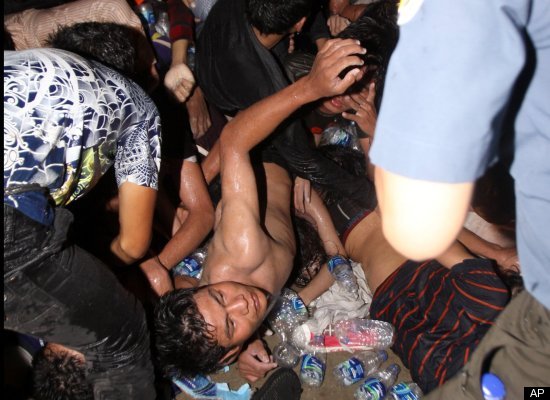
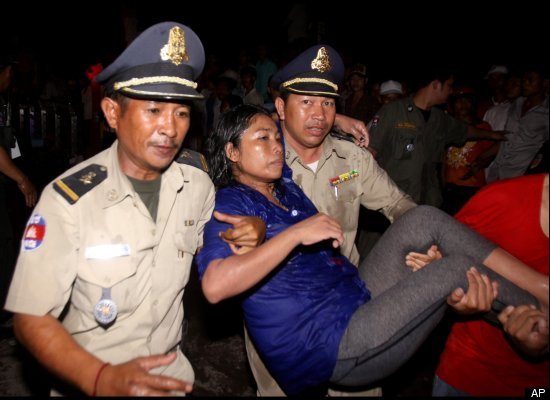
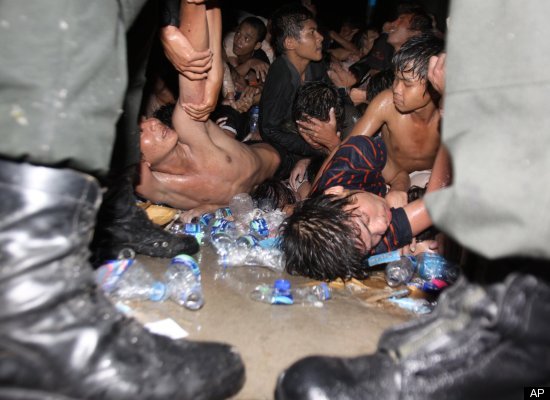
Hundreds of people have been killed in a stampede during a festival celebration in Cambodia.

Cambodia's prime minister said today the horrific festival stampede which killed at least 349 people was the country's biggest tragedy since the 1970s reign of terror by the Khmer Rouge.

Yesterday's tragedy happened as a panic-stricken crowd of thousands celebrating the end of the rainy season on an island in a river tried to flee over a bridge.

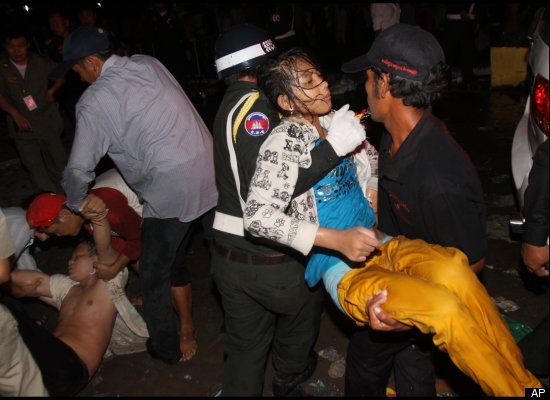
Many people were crushed underfoot or fell over its sides into the water. Disoriented victims struggled to find an escape hatch through the human mass, pushing their way in every direction. After the stampede, bodies were stacked upon each other on the bridge as rescuers rushed to the area.

"This is the biggest tragedy we have experienced in the last 31 years, since the collapse of the Khmer Rouge regime," prime minister Hun Sen said, referring to the ultra-communist movement whose radical policies are blamed for the deaths of 1.7 million people during the 1970s.

He ordered an investigation into the cause of the stampede and declared Thursday a national day of mourning. Government ministries were ordered to fly the flag at half-mast.

The prime minister said that the government would pay the families of each dead victim £780 for funeral expenses and provide £156 for each injured person.

His special adviser Om Yentieng denied some reports that the victims were electrocuted by lighting cables and that the panic was sparked by a mass food poisoning.

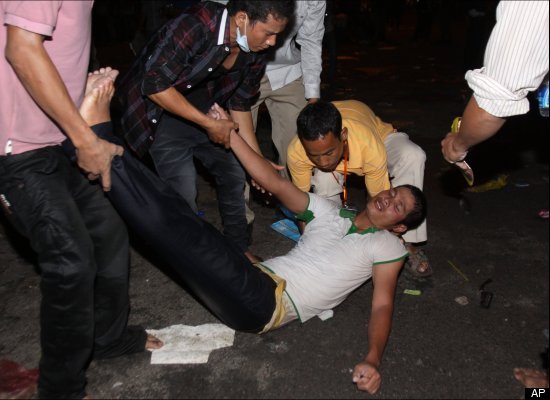
Ambulances raced back and forth between the river and the hospitals for several hours after the stampede. Calmette Hospital, the capital's main medical facility, was filled to capacity with bodies as well as patients, some of whom had to be treated in hallways. Relatives, some crying, searched for the missing today.

"I was taken by shock. I thought I would die on the spot. Those who were strong enough escaped, but women and children died ," said Chea Srey Lak, a 27-year-old woman who was knocked over by the panicked crowd on the bridge.

She managed to escape but described a woman of about 60 lying next to her who was trampled to death by hundreds of fleeing feet.

"There were cries and calls for help from everywhere but nobody could help each other. Everyone just ran," she said at Calmette Hospital, where she was being treated for leg and hand injuries.

Hours after the chaos, the dead and injured were still being taken away from the scene, while searchers looked for bodies of anyone who might have drowned. Hundreds of shoes were left behind on and around the bridge.

The government television station said 349 people had been killed and 500 injured.

Authorities had estimated that more than two million people would descend on Phnom Penh for the three-day water festival, the Bon Om Touk, which marks the end of the rainy season and whose main attraction is traditional boat races along the river.

In this year's event 420 of the long, sleek boats competed, with crews of up to 80 racers each.

The last race ended early yesterday evening local time, the last night of the holiday, and the panic started later on Koh Pich - Diamond Island - a long spit of land wedged in a fork in the river where a concert and exhibition were being held.

It was unclear how many people were on the island to celebrate the holiday, though the area appeared to be packed with people, as were the banks.

Katakanlah wahai Muhammad, sesiapa yang berada di dalam kesesatan maka biarkanlah Allah Ar-Rahman melanjutkan baginya satu tempoh yang tertentu hingga apabila mereka melihat apa yang dijanjikan kepada mereka samada azab sengsara dunia ataupun azab kiamat, maka pada saat itu mereka akan mengetahui siapakah orangnya yang lebih buruk kedudukannya dan lebih lemah penyokong-penyokongnya 75:Maryam